
How to play blackjack
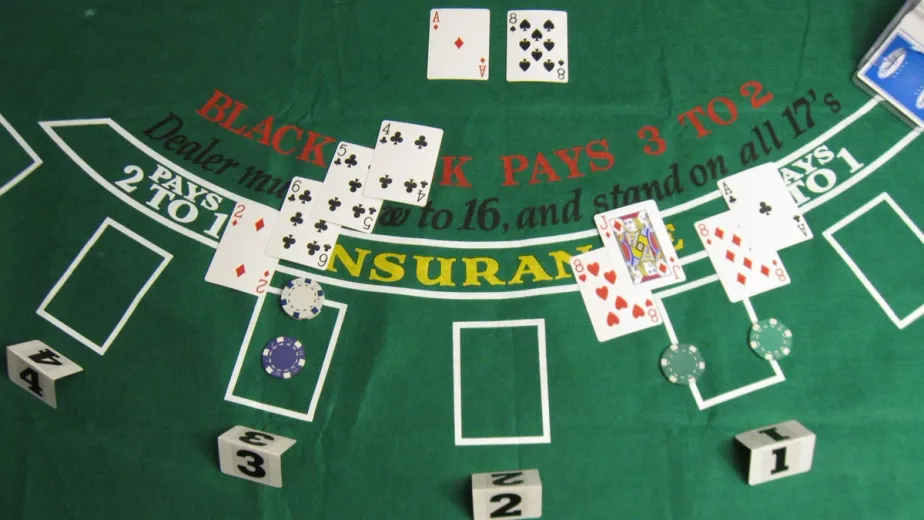 Games · Canada


Blackjack is the casino game where your decisions change the odds. Play it well at a table with fair rules and the house keeps very little; play it on hunches at a table with poor rules and it keeps several times more. Both the rules and the decisions can be checked with simple arithmetic. This guide explains the game, the table rules that cost you money, and the handful of decisions that matter most, with the numbers worked out.
The rules in one minute
- Cards 2-10 count at face value, jacks, queens and kings count 10, aces count 1 or 11.
- You and the dealer each get two cards; one dealer card is face up.
- You aim to finish closer to 21 than the dealer without going over ("busting").
- A two-card 21 (ace plus a 10-value card) is a blackjack or natural. It traditionally pays 3 to 2.
- You act first. If you bust, you lose even if the dealer later busts too. That is the house's built-in advantage.
- The dealer has no choices: it draws to a fixed rule, usually standing on 17.
Your options on each hand:
| Action | What it does |
|---|---|
| Hit | Take another card |
| Stand | Keep your total |
| Double down | Double your bet, take exactly one more card |
| Split | Turn a pair into two hands, adding a second bet |
| Surrender (where offered) | Give up half your bet and end the hand |
| Insurance | A side bet that the dealer has blackjack, offered when the dealer shows an ace |
The table rules that change the price
Not all blackjack tables are equal. Read the felt or the info screen for:
- Blackjack payout: 3 to 2 or 6 to 5. The single most expensive rule. More below.
- Dealer hits or stands on soft 17 (a 17 that includes an ace counted as 11). Standing is better for you.
- Number of decks. Fewer decks is slightly better for the player.
- Doubling rules. Double on any two cards, and double after splitting, help you.
- Surrender. Being allowed to surrender helps you.
6:5 vs 3:2
Worked example: on a C$20 bet, a 3 to 2 blackjack pays C$30; a 6 to 5 blackjack pays C$24. In a six-deck shoe you are dealt a natural about 4.75% of the time (2 x 24/312 x 96/311). The dealer also has one in about 4.6% of those cases, which is a push. So the 6:5 rule costs 0.3 of your stake on about 4.53% of hands: 0.3 x 0.0453 = about 1.36% of every bet. On C$1,000 wagered, that is roughly C$13.60 extra to the house.
That one rule can more than double the house edge of an otherwise fair table. Avoid 6:5 tables.
Insurance: the bet to skip
When the dealer shows an ace, you are offered insurance: a side bet of up to half your stake that pays 2 to 1 if the dealer has blackjack. In a six-deck shoe, after the dealer's ace is removed, 96 of the remaining 311 cards are 10-value (ignoring your own cards). So:
- Chance the dealer has blackjack = 96 / 311 = 30.87%
- Return on insurance = 30.87% x 3 (stake back plus 2 to 1) = 92.60%
- House edge = 7.40%
The same applies to "even money" when you hold a blackjack against an ace: it is insurance under another name.
Decisions that matter most
Basic strategy is the mathematically best play for every combination of your hand and the dealer's up-card, under a given set of rules. It is published for each rule set and printed on strategy cards. The core of it is easy to see with simple probability.
Why you stand on 12 to 16 against a dealer 2 to 6, but hit against 7 or higher. If you hit 16, any card from 6 to king busts you. In an infinite-deck model that is 8 of 13 ranks, a 61.5% chance. Against a weak dealer card, the dealer is likely to have to draw and may bust; against a 7 or higher, the dealer often finishes on 17 or more, so standing on 16 rarely wins. You hit because standing loses even more often.
Why hitting 12 is less risky than it feels. Only 10-value cards bust a 12: 4 of 13 ranks, 30.8%.
Rules every basic-strategy chart agrees on:
- Always split aces and eights.
- Never split tens or fives.
- Double down on 11 against a dealer 2 to 10 at most tables.
- Stand on hard 17 and above.
- Never take insurance.
For the full chart, use one printed for your table's exact rules; the differences between rule sets are small but real.
Live, digital and side bets
- Digital (RNG) blackjack deals from a virtual shoe, often shuffled every hand, at whatever speed you click.
- Live dealer blackjack is dealt on camera. Evolution's Infinite Blackjack, launched in 2018, gives an unlimited number of players the same first two cards, after which each plays their own hand. See the live casino guide.
- Side bets (perfect pairs, 21+3 and the like) pay big multiples but carry much higher edges than the main game. Check the RTP in the game's help screen.
Provincially, PlayNow Manitoba lists both digital and live dealer blackjack. Offshore casinos serving players outside Ontario and Alberta carry many variants; browse them on our table games page.
Blackjack and bonuses
Blackjack's low edge is why bonus terms weight it so little:
| Casino | Blackjack counts toward wagering |
|---|---|
| Jackpot City | 8% (Classic Blackjack 2%) |
| Grizzly's Quest | 8% (Classic Blackjack 2%) |
| V.Vegas | Excluded |
At 8%, clearing C$1,000 of wagering takes C$12,500 in blackjack bets. The game weighting guide works through the cost; the wagering calculator does it for any bonus. Many terms also treat low-risk betting patterns as irregular play. Play blackjack with cash, not a bonus.
A sensible way to play
- Choose 3 to 2 tables; walk away from 6:5.
- Learn the five rules above, then a full chart for your table.
- Skip insurance and most side bets.
- Set a session budget and a stop point before you sit down.
Blackjack's low edge makes a budget last; it does not make the game a way to earn money. The Lower-Risk Gambling Guidelines suggest no more than 1% of household income a month on gambling. Our responsible gambling page lists free help in your province. For the other low-edge table game, see the baccarat guide; for the wheel, the roulette guide.
Sources
- jackpotcitycasino.com/bonus-terms
- grizzlysquest.com/bonus-terms
- v.vegas/en/bonus-terms
- storage.mfn.se/c/aHR0cHM6Ly9tYi5jaXNpb24uY29tL01haW4vMTIwNjkvMjY1NjExMi85MzM1OTgucGRm/20181026-evolution-launches-infinite-blackjack-with-unlimited-seats-for-players.pdf
- mbll.ca/sites/mbll-ca/files/playnow_backgrounder.pdf
Questions players ask
What is the house edge in blackjack?
It depends on the table rules and how you play. With correct basic strategy on good rules it is among the lowest in the casino, typically under 1%. Poor rules (6:5 blackjack) or guessing can push it several times higher.
Why should I avoid 6:5 blackjack?
A natural pays 6 to 5 instead of 3 to 2. On a C$20 bet that is C$24 instead of C$30. Over six decks, that change adds about 1.36 percentage points to the house edge, by our calculation.
Should I take insurance?
No, not as a rule. In a six-deck game with the dealer showing an ace, insurance has a house edge of about 7.4%.
Does blackjack count toward bonus wagering?
Usually only a little. Jackpot City and Grizzly's Quest count blackjack at 8% (Classic Blackjack 2%); V.Vegas excludes it.